Bring Your Own Applications
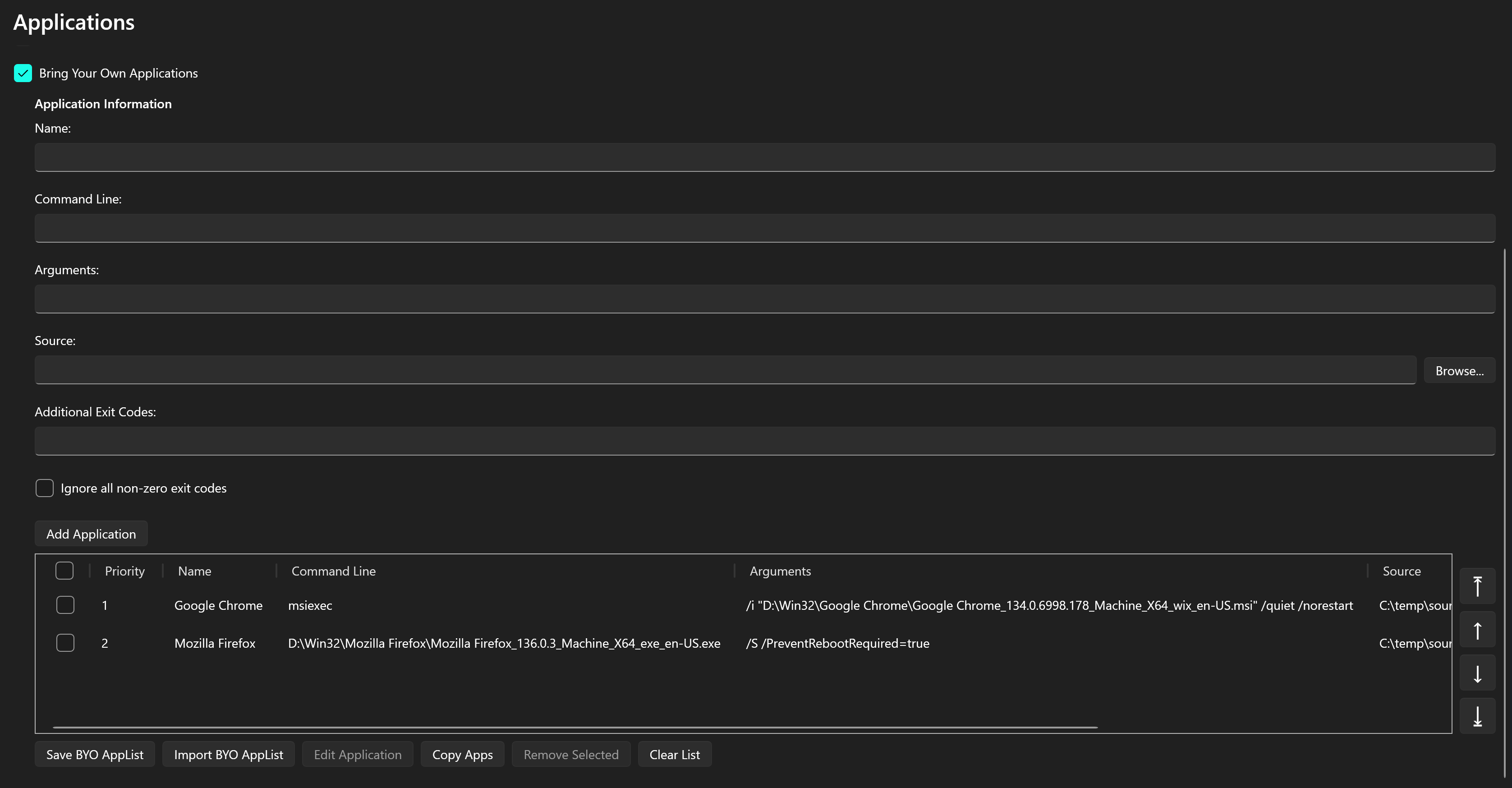
Bring Your Own Applications allows you to run any command line you want in the virtual machine to include in your FFU to install an application, run a script, etc. As the name implies, you’ll provide the content, command line, arguments, and additional exit codes.
All applications are stored in the $AppsPath parent folder which defaults to C:\FFUDevelopment\Apps. Winget source applications and BYO Apps that you select Copy Apps are stored in $AppsPath\Win32. MSStore source apps from Winget are stored in $AppsPath\MSStore.
At build time, an Apps.iso file is created from the $AppsPath folder and mounted to the VM. Use %FFUAppsRoot% in command lines and arguments to reference the mounted Apps ISO, for example %FFUAppsRoot%\Win32\MyApp\setup.exe.
Existing UserAppList.json files that use D:\ paths are still supported. If a legacy D:\ path does not exist in the VM but the same relative path exists on the Apps ISO, FFU Builder remaps it to %FFUAppsRoot% at runtime.
Name
The name of the application. The name is also used when selecting Copy Apps to copy apps from a source location to the $AppsPath\Win32\<Name> folder (e.g. C:\FFUDevelopment\Apps\Win32\Google Chrome)
Command Line
This is the full path to the command line to install the application, script, or to run a command. If the content was included in the $AppsPath, use %FFUAppsRoot% (e.g. %FFUAppsRoot%\Win32\Mozilla Firefox\Mozilla Firefox_136.0.3_Machine_X64_exe_en-US.exe). Legacy D:\Win32 paths are still supported.
For MSI applications, this should only include msiexec. The rest of the command line will be specified in arguments.
Arguments
These are the command line arguments for the application. Using the Mozilla Firefox example above, the arguments would be /S /PreventRebootRequired=true.
For MSI applications, this will include /i and the full-path to the MSI file plus any additional command line parameters (e.g. /i "%FFUAppsRoot%\Win32\Google Chrome\Google Chrome_134.0.6998.178_Machine_X64_wix_en-US.msi" /quiet /norestart)
Source
This is an optional parameter. This is the local source to the content. It is used by the Copy Apps button to copy from the source location to the $AppsPath\Win32\<Name> folder. If you don’t use the Copy Apps button, then you must put the conent in the $AppsPath folder manually.
Additional Exit Codes
This is an optional parameter. Enter a comma-separated list of additional success exit codes if necessary.
Ignore all non-zero exit codes
If checked, any non-zero exit code will be considered a success.
Save UserAppList.json
When you’re done adding your apps, you must save the UserAppList.json file to your $AppsPath folder. If you click Copy Apps, the UserAppList.json file is also saved. The UserAppList.json is used by the FFU Builder Orchestrator in the VM to know what to install and when based on the priority of the application.
Below is the UserAppList.json of Chrome and Firefox using the example above.
[
  {
    "Priority": 1,
    "Name": "Google Chrome",
    "CommandLine": "msiexec",
    "Arguments": "/i \"%FFUAppsRoot%\\Win32\\Google Chrome\\Google Chrome_134.0.6998.178_Machine_X64_wix_en-US.msi\" /quiet /norestart",
    "Source": "C:\\temp\\source\\Google Chrome",
    "AdditionalExitCodes": "",
    "IgnoreNonZeroExitCodes": false
  },
  {
    "Priority": 2,
    "Name": "Mozilla Firefox",
    "CommandLine": "%FFUAppsRoot%\\Win32\\Mozilla Firefox\\Mozilla Firefox_136.0.3_Machine_X64_exe_en-US.exe",
    "Arguments": "/S /PreventRebootRequired=true",
    "Source": "C:\\temp\\source\\Mozilla Firefox",
    "AdditionalExitCodes": "",
    "IgnoreNonZeroExitCodes": false
  }
]
Import UserAppList.json
You can import a saved UserAppList.json
Edit Application
When you select a single application you can select the Edit Application button. This allows you to edit the application information and update the application.
Copy Apps
If the application source is provided, click Copy Apps to copy the application content to the $AppsPath\Win32 folder (e.g. C:\FFUDevelopment\Apps\Win32\<Name>). Network shares are supported. When clicking Copy Apps the UserAppList.json file is automatically created.
Remove Selected
Removes the selected applications from the list view. Click Save UserAppList.json to save the application list.
Clear List
The Clear List button will clear the list view of what’s currently in it. It will not clear the UserAppList.json file if it exists.